
Migrant Kathmandu: A Study of Urban Affect
For my Harvard Mellon Urban Initiative short project, I had proposed a study of the ways in which prospective migrants interact with the built environment of Kathmandu. I was particularly interested in the extent to which bureaucratic infrastructures and institutions that discipline and legally transform domestic labor into temporary migrant workers for the global labor circuits also act as spaces that make unruly and intense affective experiences visible. I had based my proposal on research conducted prior to the CoVID-19 lockdown, which took the built environment of Kathmandu as a given. During my in-situ ethnographic fieldwork conducted in the winter of 2023, however, I found that the post-Covid construction boom in Kathmandu had fundamentally changed the city, thus altering the premise of the project.
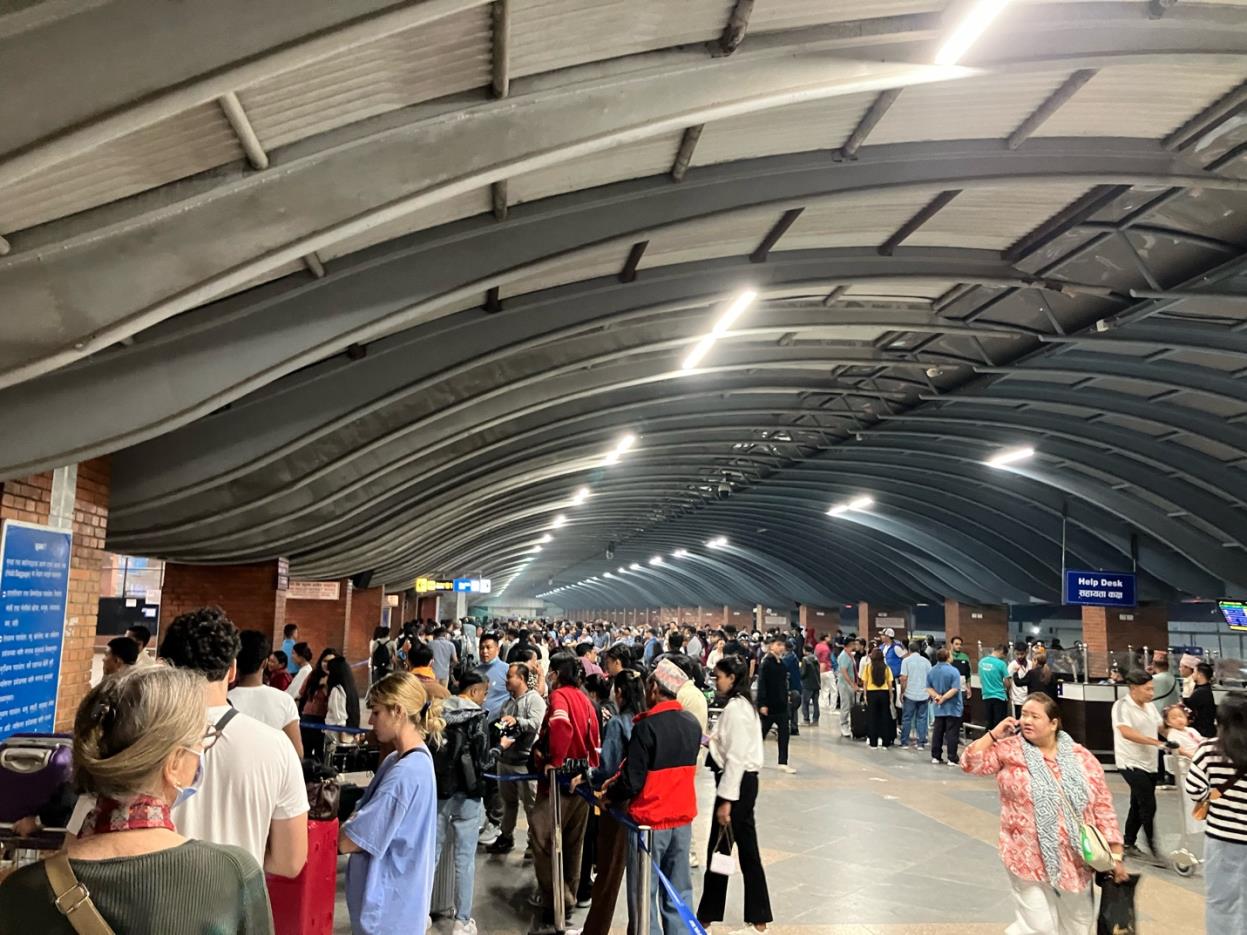
New property development and zoning laws, the increasing number of returning migrant workers with construction skills, the transformation of the mountain river ecology for sand mining, and the real estate bubble in Kathmandu have contributed to the shifts in urban development. Spaces where prospective migrant labor congregated – single-story buildings with garage-like rooms that open onto the streets which housed tea shops, copy shops, or fixers, had mostly been torn down and the “waste spaces” at the sides of roads and underneath trees are all being made commercially useful. This is especially true in neighborhoods where migrant infrastructure is most present, given the profitability of the formalized regime of mobility. Thus, the material basis of the migrant libidinal political economy in the city is fundamentally transforming. The class dynamics of these spaces have also changed. For example, while the intermediaries who work as typists and fixers still exist, their businesses have become more formalized and now mostly cater to middle class customers. On the other hand, a crucial space like the airport, initially built for upper-middle class travel, has become aesthetically as well as pragmatically geared towards the working class as it is the only point of entry into and exit out of the country for particular migrant labor circuits.
Given these changes, the nature of my research as well as the method shifted significantly. My focus on human interactions and affect in these sites receded and I instead conducted exploratory research where I gathered data on the new commercial structures through interviews, online data scraping, as well as sound and photo walks which focused on the changing materiality and aesthetics of the city. I am currently mapping out the neighborhoods in which specific migrant infrastructures like labor recruitment offices are located in order to understand how a neighborhood shifts from being a residential one to a commercial one. Furthermore, tracking such shifts in the built environment also helps me understand the shifting class dynamics as an increasing amount of people become landlords and rent collectors.
The data collected through the HMUI grant will be used in a paper that will be presented in collaborative spaces at Harvard (Political Economy/Political Anthropology Working Group) as well as in Nepal in the upcoming academic year. This research will also play a role in my dissertation as well as my CMP capstone project. It has provided crucial pre-dissertation ethnographic materials on the preconditions or the “moorings” that make formal migration possible. It has helped me to understand the landscape of diverse institutions and intermediaries that profit from migration as well as the changes engendered in Kathmandu through migration. I plan to use these findings in a chapter that will trace the history and development of formal migrant infrastructures in Kathmandu. Moreover, this data has helped me raise new research questions as I continue to conduct long-term fieldwork – for instance, what role will institutions whose primary goal has been the funneling of labor out of Nepal play in the new policies that focus on returning and retaining labor within the country?
Researcher: Ria Gyawal