
Menteng Pulo Cemeteries: A Window into Trans-Oceanic Migration to Indonesia
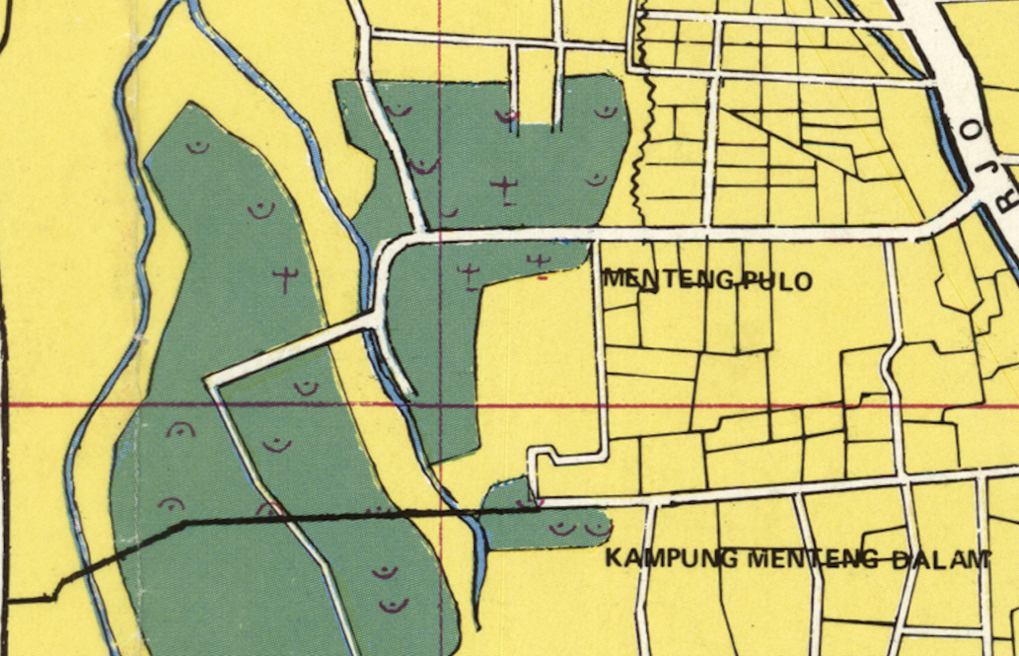
Cemeteries are more than mere “sleeping place,” as the Greek etymology (κοιμητήριον) suggests. They are sites to mourn, converse, eat, pray, love, and also find companionship amongst the dead and the living. This becomes evident at Menteng Pulo Public Cemetery (TPU Menteng Pulo I, II, III) that accommodates more than 53,000 Indonesians, Chinese-Indonesians, Japanese, Koreans, Dutch, and other backgrounds. With no fence between the cemetery and the bustling thoroughfare Jalan Raya Casablanca, their eternal sleep features in day-to-day landscape of Jakarta, especially when everything is in slow motion orchestrated by the “absolute traffic” jam (Lee 2015) in Jakarta.
This cemetery exists adjacent to a parallel side Ereveld Menteng Pulo, maintained by the Netherlands War Graves Foundation (OGS) since its inauguration as a Dutch war cemetery in 1947. Unlike Menteng Pulo Public Cemetery that continues to welcome newcomers, Ereveld Menteng Pulo stands still as a poignant reminder of the turbulent era of World War II, encompassing both the Dutch and Japanese overlapping occupations (1942-1945) and the subsequent Indonesian War of Independence (1945-1949). Here, approximately 4,000 Indonesian and Dutch victims rested for peace, and hopefully in peace.
Thanks to the Harvard Mellon Urban Initiative, I have explored these two cemeteries as a unique lens through which to observe the rapid urbanization in Jakarta and trans-oceanic migration to Indonesia including that of Koreans. The presence of ethnic Korean graves in Menteng Pulo Public Cemetery, contrasted with their absence in Ereveld Menteng Pulo, highlights both sites equally important to unpack Korean migration to Indonesia. This project thus deepens an aspect of my dissertation, which examines the historical development of the Korean diaspora alongside company towns in Indonesia from an anthropological perspective. Tracing the origin of the Korean community in Indonesia has required me to situate Koreans within a broader network of Asian migrants, mainly due to their lack of presence in archival records compared to Chinese and Japanese communities.
Traces of their presence can be discerned through careful interpretation of tricky names in Chinese and/or Japanese. During the Japanese colonial period in Northeast Asia, identifying as Chinese, Japanese, or Korean was not necessarily mutually exclusive. The deceptive nature of Japanese names becomes clear, surprisingly, in Indonesia―another former Japanese colony where Indonesian and Korean histories intersect through the shared experience of Japanese colonial rule from 1942 to 1945. Their shared time and space during the Pacific War provide a unique window into unexplored postcolonial discourse and migratory dynamics, as can be unearthed, literally, in Indonesian cemeteries.
With support from the Harvard Mellon Urban Initiative, I achieved two primary goals. Firstly, I conducted interviews with cemetery builders, caretakers, visitors, and urban sketchers over the past year. This data, combined with other information I gathered as a Pforzheimer Fellow at Harvard Library, forms the foundation for analyzing an understudied history of trans-oceanic migration to Indonesia and the socio-cultural dynamics which it gave rise to. Secondly, I have been able to restore broken citations and geospatial data related to overseas Chinese cemeteries, originally curated by Dr. Terry Abraham.
The Terry Abraham Web Archive preserves a wealth of scholarly and archival works of Dr. Terry Abraham (1944-2018), originally hosted on early websites of the University of Idaho. Dr. Terry Abraham, who served as the head of Special Collections & Archives for over two decades, offered steadfast support to the archivist and librarian community. He also compiled rare geospatial data such as overseas Chinese cemeteries and a census on Chinese funerary burners. However, this Web Archive now includes a disclaimer stating: "Please note: this archived page is preserved for historical reference. The content is not maintained, is out of date, and may not display as originally intended." Unfortunately, this disclaimer applies to both the Overseas Chinese Cemeteries published online in 2015 and a census on Chinese Funerary Burners from 2012. Most of the map web URLs are broken and have not been archived in the Wayback Machine. Therefore, I have begun the task of restoring and updating these geospatial data and related citations. During this process, I encountered discrepancies where some of the restored geo point data do not accurately align with today’s Google Maps. These discrepancies may stem from changes in mapping systems and alterations in land use over time. To address these challenges, I have made necessary adjustments to ensure precise marking of locations for current users. For example, certain geo points of a masonry burner appeared to have vanished. In such cases, I have marked the nearest cemetery around the original geo point. Adjustments made to the data are highlighted in blue, while restored data is marked in yellow. Missing citations are noted accordingly where they could not be located or restored. Additionally, I had difficulty in locating some citations.
In these instances, I identified the most similar or closely related source and included it beneath Dr. Terry Abraham’s original listing, distinguishing it with an unitalicized format. Other references requiring more time for restoration or adjustment have been retained in their original form.
The findings from this research, including ethnographic data and updated archival and geo-spatial data, will be disseminated through academic journals and digital story maps. For those interested in the restored and adjusted data of overseas Chinese cemeteries, please find the link here to preview the ongoing work-in-progress. As of July 2024, I have fully updated data for India and Indonesia, with Australian data partially updated from Albury to Parkes. In honor of Dr. Terry Abraham, I hope to maintain and expand these updates over time.
Researcher: Gangsim Eom